

What is Fine Art Giclée Printing, and What Is Its History?

What is Fine Art Giclée Printing, and What Is Its History?
Images of Henry by Wilhelm fromWilhelm Imaging Research, Inc. Courtesy of Nash Editions for Color3arte
What is Fine Art Giclée printing?
The world of fine art printing has undergone a dramatic transformation since 1991, when the term “Giclée” first appeared to describe what is also known as fine art prints.It is a truly innovative concept in which technology, human talent, and top-quality resources come together in perfect harmony to produce works of art.
Giclée, a French term
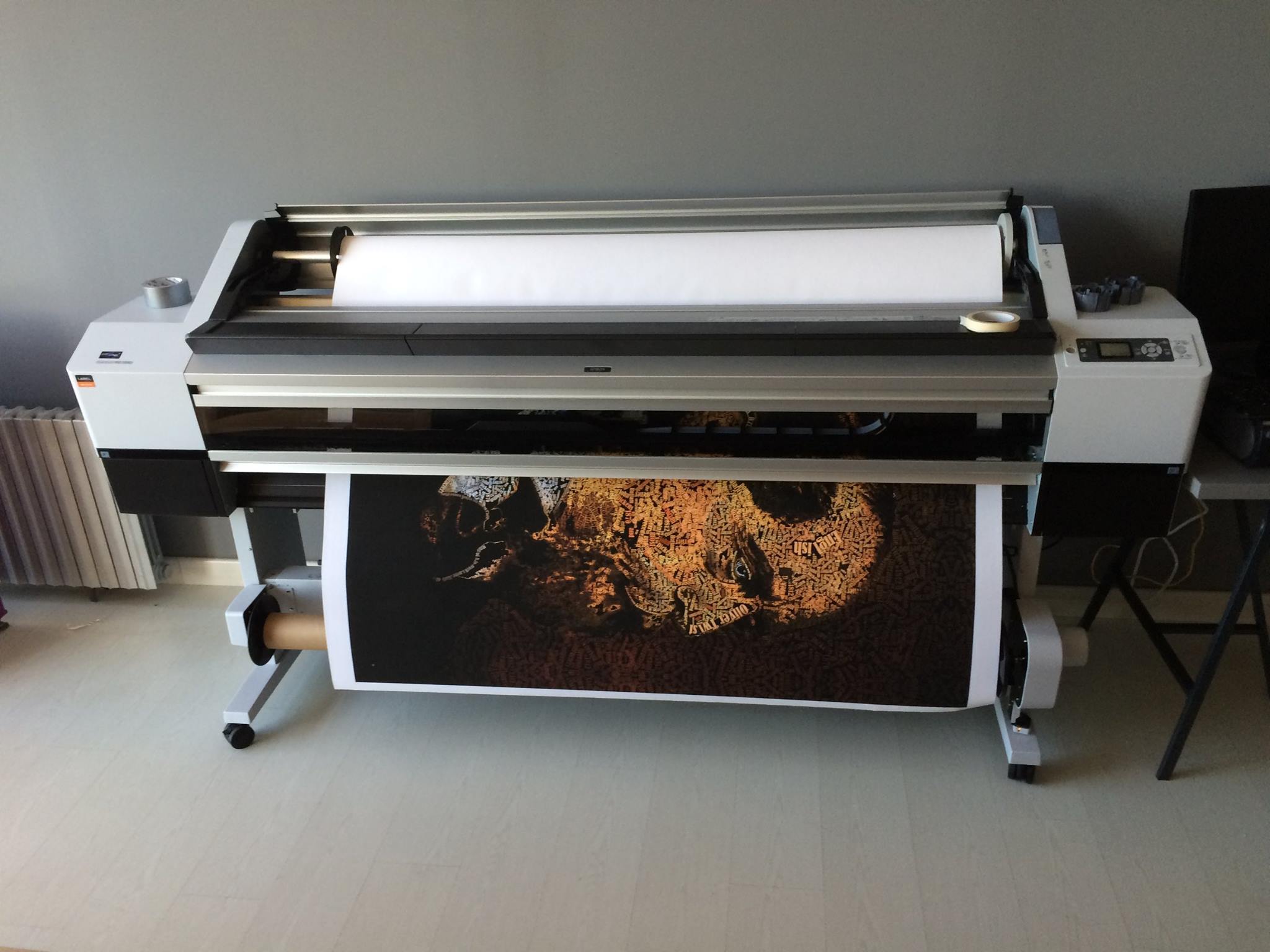
Giclée, a French term pronounced “yiclé,” is an image printing technique whose name derives from the verb “gicler,” meaning “to spray.” It involves spraying pigment in the form of microscopic droplets onto the canvas or paper in a continuousstream , much like a high-pressure spray nozzle.
Unlike most continuous-ink printers, which release controlled amounts of ink only when necessary,in the Giclée printing process,ink is applied to the substrate with millimeter precision and under high pressure,thanks to a vibration system using piezoelectric glass components. In this process,the ink droplets are given a specific electrical charge so thatthose that are not neededare electrostatically deflected into a waste collection system that does not interfere with the printing process.
This system, which—like all technology—requires a level of precision that seems almost miraculous, produces prints of a sharpness that would be unimaginable under any other working method. That is why it is so highly valued as a printing method. Thanks to the use of special inks and papersspecific to this technique, fine art prints are guaranteed to last almost forever.
The Wonders of Giclée
One of the wonders of giclée printing is its ability to capture the precise details of forms. Even if other methods were used for this purpose, without fine art printing techniques, certain edges, textures, and patterns that define the image would not be reproduced on paper with such precision, andthe continuous tone—especially in grays or blended shades—would not be as accurate.
Furthermore, “fine art” is a term directly associated with papers of the highest quality. It is not just an empty label; the paper used in fine art printing must meet very specific quality criteria. We’re talking about papers whose composition differs significantly from standard photo paper; they’re made of natural fibers, mostly cotton or alpha-cellulose, haven’t been artificially bleached with chlorine,have a neutral pH, and undergo a special treatment that ensures the print’s longevity.

What is Fine Art Giclée Printing, and What Is Its History?
Un pionero en el uso de impresoras de inyección de tinta en color de alta resolución en el campo de las bellas artes es Nash Editions. Ubicado cerca de Los Ángeles en Manattan Beach, California, Nash Editions fue fundada por el británico Graham Nash del legendario grupo de rock de los años 60 Crosby, Stills, Nash & Young. Nash, un gran fotógrafo y coleccionista, se sintió atraído por el proceso de inyección de tinta como un medio para imprimir fotografías que había escaneado y trabajado con el software Adobe Photoshop en su computadora Apple Macintosh. Aquí se muestran los miembros del personal de Nash Editions (de izquierda a derecha) Jack Duganne, R. Mac Holbert y Graham Nash. Esta fotografía y las fotografías de la página siguiente fueron tomadas por el autor durante una visita a Nash Editions en febrero de 1992, poco más de seis meses después de su apertura comercial. <www.nasheditions.com>
History of Giclée Printing
Jack Duganne, an expert in the field of printing and head of the Fine Arts department at Nash Editors, coined the term “Giclée” to describe this unique method of printing images. IIn 1991, he realized there was a need to clearly distinguish between the types of printing produced by the famous Iris printers, which had already coined the term “Iris Proof” for a type of high-quality printing—which was actually considered a proof—before the job was ordered in large quantities.
Giclée
This well-known printing method had the drawback of appearing too industrial, not quite in keeping with the spirit of the craft—if you will, artisanal—yetof the high qualitydemanded by the artists,photographers , and graphic designers of the time.
To achieve this distinction and meet the technical demands of the market, Duganne drew on the verb “glycer” to find a word that would set his work apartfrom industrial block printing. This was due, above all, to a technological innovation that originated in Stoneham, Massachusetts, the headquarters of Iris Graphics.

Jack Duganne and Holbert are working on an image in Photoshop on an Apple Macintosh computer with New York City fashion photographer George Holz (center).

The first location of Nash Editions, which was originally housed in this picturesque building, not far from Los Angeles International Airport.
Images of Henry by Wilhelm fromWilhelm Imaging Research, Inc. Courtesy of Nash Editions for Color3arte
What is Fine Art Giclée printing? And what is its history?
In the mid-1980s
Two employees of Applicon, the leading company in the field, founded Iris Graphics, Inc., and developed its Iris printers, which quickly became the preferred method for reproducing graphic works on various media: paper, canvas, silk, linen, and certain textiles. It was very well received by printing specialists, photographers, artists, and even color engineers, as they were indeed dealing with a printer capable of producing high-quality images with exceptional color definition—so much so that it was selected by David Coons, the color engineer at the Walt Disney Company,to print the new 3D images from Disney Studios.
Fun Fact
It was Coons who wrote the printing manual for such major projects as Sally Larsen’s “Transformer” series, published in 1989, and for a 1990 exhibition by Graham Nash of the supergroup Crosby, Stills, and Nash. Nash is a photography collector and a published photographer who was so impressed with the quality of the reproductions of his works presented in the exhibition that he invested $126,000 in an Iris printer and founded Nash Editions, where Duganne coined the term “Giclée” for the work they were doing.


Iris inkjet printers apply the cyan, magenta, yellow, and black images in a single pass, with the printing material attached to a rapidly rotating drum. With the cover removed, the main band of the image printed by the cyan inkjet, which moves slowly across the image from left to right, is clearly visible. Photo 2: Bottlesof the water-based inks used in Iris inkjet printers. Initially designed for graphic arts proofing, standard Iris inks have very poor lightfastness. Inks made with dyes that have improved lightfastness for fine art and photography applications became available in 1994.
Most likely, without the initiative of those two Applicon employees, Graham Nash’s vision, and Jack Duganne’s expertise, the world of fine art printing would not be the same—and perhaps the possibility of producing images whose sharpness and color are exactly as the artist envisions them in his mind before daring to put them on paper would not exist.

Crosby, Stills & Nash (CSN) is a folk-rock supergroup consisting of American singer-songwriters David Crosby and Stephen Stills, and English singer-songwriter Graham Nash. When Canadian singer-songwriter Neil Young joins them as the fourth member, the group is known as Crosby, Stills, Nash & Young. Courtesy of Wikipedia
At COLOR3ARTE
Our commitment to honoring this creative process is closely linked to the deep respect we have for our clients—mostly graphic designers from diverse backgrounds, with varying styles and approaches—who want to see their work brought to life on paper exactly as they envisioned it when they first created it. Images are the narrative tool most likely to remain in human memory forever. That is why at COLOR3ARTE we are committed to preserving history, because we are aware that when there is nothing else to rely on to weather the times, there will be images that narrate the only thing that stirs human memory; that is why we do not compromise on the high quality of our work. Simply put, we prioritize it above all else.
What is Fine Art Giclée printing? And what is its history?






Recent comments