
Monoprints 1/1 — original, unique, and certified artwork
Monoprints are unrepeatable impressions: a single combination of gesture, ink, and substrate gives rise to the image. Inspired by the explorations of Edgar Degas, Mary Cassatt, and Paul Gauguin, these works bring into the present — and into the digital realm — the ambition to create absolutely unique graphic artworks.
What is a monoprint?
A monoprint is the synthesis of graphic art and a unique piece: from a single file — digital art, photography, or the digitization of a classical work — one single Fine Art pigment print (1/1) is produced, signed, certified, and supported by the artist’s written commitment never to produce another print with identical visual characteristics. In this way, the file becomes an art object, and that sole exemplar is consecrated as an absolute and unrepeatable original.
At Color3arte we produce 1/1 monoprints to Fine Art standards for collectors: we manage file preparation and color workflow, select papers of maximum permanence, and apply a final verification process with robust certification.
What is the value of a monoprint?
Unrepeatable original — only one exemplar exists, reserved for the collector.
Authorial intent — not a “copy,” but conceived from the outset as a singular work.
Technical excellence — file preparation, color management, substrate selection, and proofing are handled with rigorous Fine Art standards.
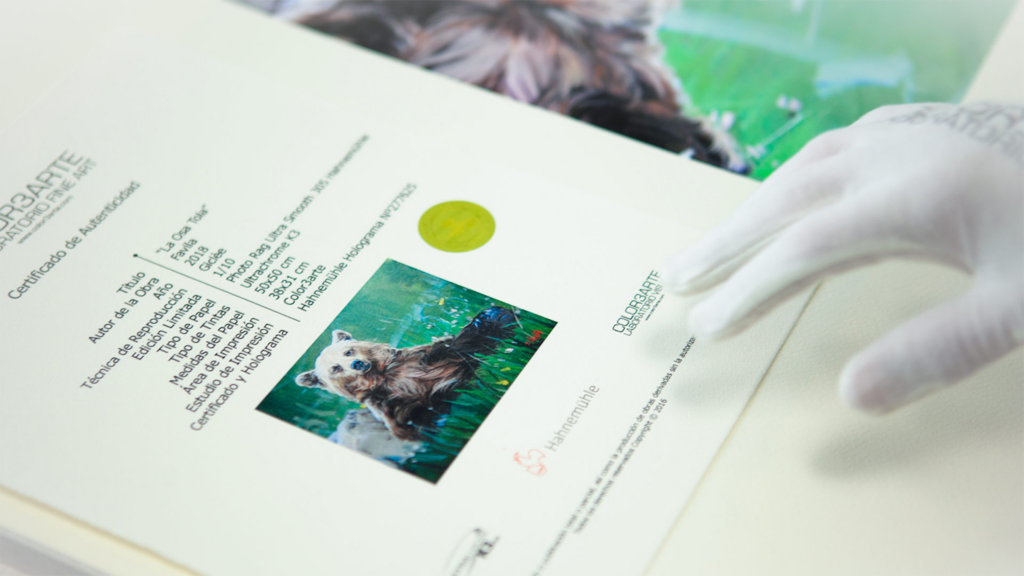
Guarantee and traceability — a physical certificate and NFC registration safeguard the artwork and its ownership.
How a Fine Art Monoprint Is Produced at Color3arte
A serious monoprint cannot be reduced to “just printing.” For a 1/1 artwork to be coherent, stable, and collection-ready, the workflow is structured around four core stages.
1) File Preparation
We review the elements that genuinely affect the final result: effective resolution, gradient integrity, color space consistency, and precise control of shadows and highlights to prevent shadow blocking or highlight clipping.
2) Color Management and Soft Proofing
The objective is precise: to predict how the image will behave on the selected paper. Soft proofing enables technically informed adjustments while preserving chromatic fidelity and respecting the inherent character of the paper.
3) Paper Selection
Paper is not a neutral support. It defines texture, micro-contrast, perceived saturation, and—critically—the reading of black values.
For monoprints, we work with Hahnemühle vegan Fine Art papers, a compelling choice when environmental coherence is also a priority.
4) Printing and Final Verification
The print is evaluated under controlled lighting conditions, assessing what truly matters: uniformity, shadow detail, neutrality, and chromatic consistency. The objective is a gallery-grade result—stable, refined, and archivally sound.
Hahnemühle Vegan Fine Art Paper: Quality, Longevity, and Coherence
Hahnemühle states that its papers are vegan and that this decision has been part of its manufacturing philosophy for decades: internal and surface sizing do not rely on animal gelatins, but on synthetic compounds.
In practical terms, for a monoprint this translates into:
-
Surface quality and tactile presence — a tangible sense of the artwork as object.
-
Color rendering — texture and coating influence how the pigment interacts with the paper surface.
-
Deep blacks and micro-detail — particularly valuable in photography, painting, illustration, and comic art.
-
Archival orientation — substrates designed according to stability and aging-resistance criteria.
Water-Based Pigment Inks: Color, Definition, and Stability
For Fine Art monoprints produced using the giclée process, the professional benchmark is water-based pigment inks.
They deliver clean color, fine detail, and long-term stability when paired with appropriate Fine Art papers. The result is an image with stronger presence: deep blacks, smooth tonal transitions, and a distinct object-like quality.
Epson, for example, defines UltraChrome PRO12 as a water-based pigment ink system—highly regarded in Fine Art printing for its precision and conservation-oriented performance.
Visible Quality: Color, Deep Blacks, and Dmax
In a monoprint, viewers typically perceive two elements before anything else: color richness and black depth.
-
Color — not merely saturation, but cleanliness, coherence, and smooth tonal transitions.
-
Black and Dmax — a high Dmax value ensures deep blacks with presence while preserving shadow detail, enhancing volume, legibility, and visual impact.
Durability and Conservation: A 1/1 Artwork Is Made to Last
A monoprint is conceived as an artwork, and its longevity depends on the entire system—file, ink, paper, and handling conditions. Simple guidelines make a substantial difference:
-
Avoid direct sunlight or aggressive spot lighting.
-
Maintain stable humidity and temperature conditions.
-
Handle with gloves or by clean edges only.
-
Frame using archival-grade materials
Papeles Hahnemühle
Estudio Certificado Gold por Hahnemühle
Certificado Holográfico Numerado de Hahnemühle

Chip de Autenticación Digital




The Monoprint as a Production Framework
A monoprint does not belong to a single discipline; it is a production framework and an edition commitment. It consists of materializing an image as a unique object (under clearly defined conditions: size, substrate, process) and supporting it with verification and traceability.
For that reason, it is particularly effective in the following contexts:
Fine Art Photography: The “Original” as a Commitment to Uniqueness
In photography, a 1/1 monoprint means declaring that the image will exist only once in the physical world, in a specific size and on a defined substrate.
Verifiable exclusivity — 1/1 in that size and on that paper, with formal certification.
Material reading — the paper (and its finish) defines character and transforms the image into an object.
Technical file coherence — control of gradients, blacks, and color ensures a consistent and defensible result.
Digital Art Brought into the Physical Realm: When the File Becomes the Artwork
Digital illustration, digital painting, 3D rendering, collage, hybrid imagery, or generative works: the monoprint allows the final version to be closed as a unique object, produced under Fine Art standards and protected by a certification system that safeguards both artist and collector.
Materialization without ambiguity — a single final piece, not a series.
Functional traceability — clear metadata and documentation linked to the artwork.
Market and collection value — facilitates provenance, insurance, resale, and exhibition loans.
Comic Art and Illustration: Why the Format Works Exceptionally Well
In comic art, black is not mere fill; it is atmosphere, rhythm, and narrative structure. A Fine Art monoprint enables a 1/1 piece with genuine object presence, particularly compelling for:
-
Alternative covers conceived as a unique 1/1 artwork.
-
Character illustrations for collectors.
-
Reinterpreted iconic pages or key narrative moments.
-
Chromatic variants (colorways) produced as a single unique piece.
-
Works incorporating subsequent manual intervention.

